The Peloponnesian War was fought after Athens, Sparta, and the other great Greek nations united to defeat the Persian army. However once the war was over Athens looked to take over all of Greece with their new Democratic government. Sparta did not take very fondly to this and so a 2 wars was waged between Athens and Sparta for control of Greece. Athens was soon defeated and Greece finally fell to the new Roman power.
Showing posts with label by: Patrick Swisher. Show all posts
Showing posts with label by: Patrick Swisher. Show all posts
Monday, December 5, 2011

The Athenian Navy
With Sparta controlling the ground power in Ancient Greece, Athens had to figure out a way to use what they had to gain a thresh-hold on some power. They did this by using the largest thing avaible to them and that was the coastline and the sea. Athens build a huge naval fleet, which was unmatched during its time. They did this to help protect their new found Democratic government from any attack. It also gave them a new form of mobility that was difficult to find in any other part of the ancient world. The fleet was massive, as were the ships as well. The video below gives specific details about these ships and how they were used in combat.
The Most Potent Greek Weapon
The standard infantry soldier in any Greek army, Spartan or any other, carried two very potent and deadly tools. A long throwing spear, which was used to kill enemies at a distance and take out cavalry forces; and a short sword, also considered to be a dagger, used at short range or when the defense line was broken by the enemy. However, with both these at the ready, one would not suspect that the most danger weapon wielded by the Greeks was their shield. It was called the Hoplon shield, and it was developed by the Spartans. This video below explains the making and use of the shield:
The Life of a Spartan Warrior
 The formation of a great Spartan Warrior started before he was ever even born. The Spartan elders would force the fastest and strongest Spartan women to mate with the quickest, nastiest, strongest males they could find. This was in hope that the child of these two would be a grand soldier and be able to withstand any test thrown his way. Once the baby, or “new warrior”, was born the elders would take them away from the parents to be inspected. If the child was well-fit, and strong looking he was kept and prepped to begin military training. If the child was seen in any way to have a mutation, birth-defect, or was just seen as too small in stature to do his army any good, he was thrown from a cliff; into a chasm known to the Spartan people as “The Deposits”. Than once the Spartans boys turned about age 7 they were stripped away from their mothers and sent to a military boarding school. It has been said that this removal from the family and sending to a military school did not only strengthen their military skills, but it also help them formulate a close relationship with the other boys in their “class” who they would one day be fighting next to.
 Once they were arranged in their “classes” the boys began their rigorous education which consisted of tough physical, mental, and spiritual tests. These “tests” were said to be quite brutal in nature and if a male failed numerous tests, and was not adversely intelligent in Greek religion making him able to become a government official, he might be killed; being seen as weak and unworthy. The boys were also pitted in battle with other boys by instructors to help them become one with the art of hand-to-hand combat. Adolescents in the boarding schools were also even sent on trips with a single goal of killing a Helot. These killing spires were scene as the last piece of the puzzle for the Spartan young and it marked their final step toward military service.
 Once the youth in the boarding school turned age 20, they “graduated” from the boarding schools and moved in barracks; marking their transition to full time soldier. While living in the barracks these men were not only expected to defend Sparta and perfect their military tactics, but get married and have children; increasing the population. However, they were not often permitted to leave the barracks and even if a family was created, they were still to live in the barracks; rarely seeing their families. The military service was not considered completed until age 40, however just because a warrior turned 40 it did not mean his time in the military was up. He could continue to see service up until, or about age 60. There are records, however, of service men of about age 65 protected armories within or around the city of Sparta. These numbers did not mean much, however, as life in the Spartan military was often short lived. Men died on the battle field in great numbers and Sparta always seemed to be at war with somebody.
 Sparta: The Men, The Military, The Government
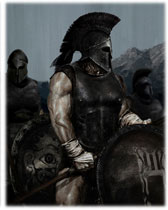 The Spartan Military was one of the most armies in the ancient world. There vast conquests are still deeply analyzed by historians today. They were a unique society in their own right, as when other Greek city-states were focused on social or spiritual risings; Sparta was concerned with conquest and the power of their army. This desire to fight was needed as Sparta was always under siege from neighboring pirates of different sects and descents. Spartan Military men were the best fit and strong individuals in the world at the time; their great power was matched by few. Yet even though Sparta was so entrenched in war and their military they were still able to expand their government, bettering their society as a whole.
 According to AncientMilitary.com:
The Spartan City State (Sparta) produced what is probably the most iconic military in ancient history. The ancient Spartan warriors are known for their bravery, professionalism and skill, a reputation well deserved. At their zenith they proved themselves to be the best of the Greek hoplite warriors, the premier fighting force of their time. Spartan political power peaked from the 6th to 4th century BC; however Spartan military power had its roots much earlier.
The evolution of the Spartan army began during the heroic Mycenaean age (1600 BCE to 1100 BCE), a time in Greek history when tactics were simple and warriors sought individual glory (and fought out of formation). Invading warlike Indo-Europeans attacked from the North in one part of histories’ most massive invasions, spanning the ancient near east from Egypt to India. Waves of invaders vied for land with the local populations.
Sparta was known for being the only Greek city without a city wall, a famous saying among Spartans went something like, “Our men are our walls.”
Subscribe to:
Posts (Atom)